



Child Account:

ACME-Enabled SSL Certificates

Trusted SSL. Fully Automated. Always Up-to-Date.

Automate your SSL Lifecycle — Issue, Validate, Renew, and Replace SSL Certificates Automatically with ACME-Compatible Clients.

ACME Automation

Continuous Coverage, No More Expired Certificates

Whether you're securing a single website or managing certificates at scale, ACME-enabled SSL subscriptions reduce manual administration, simplify renewals, and help you stay ahead of shorter certificate lifecycles.

Choose from a wide range of options from leading Certificate Authorities.

What is ACME?

ACME (Automated Certificate Management Environment) is an open industry standard used to automate SSL certificate management. Rather than manually requesting, installing, replacing, and renewing certificates, organizations can use ACME-compatible software to manage these processes automatically.

ACME automation is achieved through the combination of:

  • An ACME-enabled SSL subscription
  • A compatible ACME client
  • A supported validation method
  • Access to the organization's DNS or hosting environment

Together, these components create a secure and automated certificate management workflow.

How ACME Automation Works

An ACME-enabled SSL subscription provides the certificate entitlement and enrollment credentials required to automate certificate management using the ACME protocol.

Once connected to a compatible ACME client and configured with an appropriate validation method, certificates can be automatically issued, renewed, and replaced throughout their life cycle.

Automation capabilities vary based on the deployment environment, ACME client, and validation method selected.

Automation Benefits for SSL Management and Shorter Certificate Lifespans

Modern SSL automation eliminates the entire manual certificate life cycle and turns it into a reliable, always-on (and hands-off) process that keeps customers secure and your websites online.

Set It and Forget It

ACME-enabled deployments can automatically issue, validated, installed, and renewed before expiry.

Configure Once, Renew Automatically

Once deployed with a compatible ACME client, certificate issuance and renewal can be performed automatically without manual certificate replacement.

Scales with Shorter Validity Periods

Handles higher renewal frequency (200 → 100 → 47 days) without added workload.

Reduce Certificate Expiry Risks

Automation helps reduce the risk of expired certificates caused by missed renewal deadlines or manual processes.

Reduces Manual & Operational Workload

Less manual tracking, freeing IT teams from ongoing certificate management.

Supports Modern Infrastructure

ACME is compatible with many popular hosting environments, web servers, cloud platforms, and DevOps workflows.

Built on an Industry Standard

ACME is an open and widely adopted protocol supported by hosting platforms, server software, and certificate management tools throughout the industry.

Reduce Administrative Overhead

Automation minimizes routine certificate maintenance and allows technical teams to focus on higher-value work.

What's Included with an ACME SSL Subscription?

Everything you need to connect your SSL certificate to an ACME-compatible client and automate the certificate lifecycle:

  • SSL certificate entitlement
  • ACME Directory URL
  • EAB Key ID and HMAC Key
  • Automated certificate issuance and renewal support
  • Unlimited certificate reissuance (where supported)

Additional tools may be required for:

  • ACME client software
  • DNS hosting or DNS automation services
  • SSL monitoring tools
  • Enterprise certificate management platforms

Some automation and management capabilities may require additional software, services, or Webnames solutions.

User checking their automated acme subscription

Don't Wait to Automate SSL Administration

Keep renewals and deployments on track and stay seamlessly ahead of lifespan changes.

200
days
March 2026
100
days
March 2027
47
days
March 2029

As SSL lifespans get shorter, manual management will become less sustainable and increasingly risk prone. Shorter validity periods increases the risk of SSL certificate expiration and likelihood of gaps in ownership, sudden outages, failure of critical business systems, as well as breaches and exploits such as damaging Man-in-the-Middle attacks (MITM). Implementing SSL Certificate Automation earlier will reduce.

Automated SSL Certificates

Choose from 6 Automated SSL options from leading
Certificate Authorities (CAs)


No SSL certificates matching the selected critera were found.
Clear filters or view featured certificates.

{{certificateProduct.MarketingLabel}}

{{certificateProduct.ProductName}}

On Sale {{ctrl.dicSSLPricing[certificateProduct.ProductCode].Currency}}{{ctrl.dicSSLPricing[certificateProduct.ProductCode].PriceLabel}}/year
{{ctrl.dicSSLPricing[certificateProduct.ProductCode].Currency}}{{ctrl.dicSSLPricing[certificateProduct.ProductCode].PriceLabel}}/year

Fully automated issuance, installation and renewal

  • Validation Type: DV
  • Automation: issuance, installation, renewal; no manual administration required
  • Reissue: Unlimited
  • Issuance: Minutes
  • Warranty: $10,000
  • Site Seal: Static
  • Compatibility: Apache (Linux), NGINX (Linux), and IIS (Windows)
  • Trust: Established, reputable CA brand

Fully automated issuance, installation and renewal

  • Validation Type: DV
  • Automation: issuance, installation, renewal; no manual administration required
  • Reissue: Unlimited
  • Issuance: Minutes
  • Warranty: $500,000
  • Site Seal: Dynamic
  • Compatibility: Apache (Linux), NGINX (Linux), and IIS (Windows)
  • Trust: High trust certificate brand

100% automated - including certificate request, validation, issuance, installation and renewal

  • Validation Type: DV
  • Reissue: Unlimited
  • Issuance Time: Minutes
  • Warranty: $500,000
  • Automation: issuance, installation, renewal; no manual administration required
  • Site Seal: Dynamic
  • Compatibility: Apache (Linux), NGINX (Linux), and IIS (Windows)
  • Trust: High trust, globally recognized certificate brand

100% automated - including certificate request, validation, issuance, installation and renewal

  • Validation Type: DV with Wildcard coverage for unlimited subdomains on the same domain name
  • Automation: issuance, installation, renewal; no manual administration required
  • Reissue: Unlimited
  • Issuance Time: Minutes
  • Warranty: $500,000
  • Site Seal: Dynamic
  • Compatibility: Apache (Linux), NGINX (Linux), and IIS (Windows)
  • Trust: High trust, globally recognized certificate brand

RapidSSL DV Certificate with fully automated issuance, installation and renewal

  • Validation Type: DV
  • Automation: Included
  • Reissue: Unlimited
  • Issuance Time: Minutes
  • Warranty: $10,000
  • Automation: issuance, installation, renewal; no manual administration required
  • Site Seal: Static
  • Automation Compatibility: Apache (Linux), NGINX (Linux), and IIS (Windows)
  • Trust: Established, reputable CA brand

RapidSSL Wildcard DV SSL with fully automated issuance, installation and renewal

  • Validation Type: DV with Wildcard coverage for unlimited subdomains on the same domain name
  • Automation: issuance, installation, renewal; no manual administration required
  • Reissue: Unlimited
  • Issuance Time: Minutes
  • Warranty: $10,000
  • Site Seal: Static
  • Compatibility: Apache (Linux), NGINX (Linux), and IIS (Windows)
  • Trust: Established, reputable CA brand

Compare Automated/ACME SSL Certificates

Note: All ACME (Automated Certificate Management Environment) SSL certificates require prior implementation of an ACME client to your web server.


Certificate & CA Brand Domains Protected Validation Level Warranty Site Seal
{{certificateProduct.ProductName}} Single Multi Wildcard Domain (DV) Organization (OV) Extended (EV) ${{certificateProduct.WarrantyAmount/1000000}}M ${{certificateProduct.WarrantyAmount/1000}}K ${{certificateProduct.WarrantyAmount}} Dynamic Static None Add to Cart

What our SSL customers are saying

"When I had a SSL issue arise, Webnames’ support team responded in nanoseconds and resolved my issue. This is the kind of response and support I have become accustomed to with Webnames."

Jack Graber
www.homelink.ca

Optional Services That Complement ACME

Organizations with more advanced requirements may choose to combine ACME-enabled SSL subscriptions with additional Webnames services.

Enterprise SSL/TLS Certificate Admin Toolkit

Simplify certificate management at scale. Tag, clone, pre-validate, and revoke SSL/TLS certificates with ease—giving your team the control and efficiency needed to manage large, complex environments.

ACME-Compatible DNS Automation

Accelerate issuance and validation with seamless automation. Integrate with the Webnames JSON/REST API to streamline DNS validation and certificate deployment, reducing manual effort and improving speed.

SSL Certificate Monitoring

Stay ahead of expirations and risks. Automated SSL status scans and real-time alerting ensure your certificates remain active, valid, and fully protecting your systems at all times.

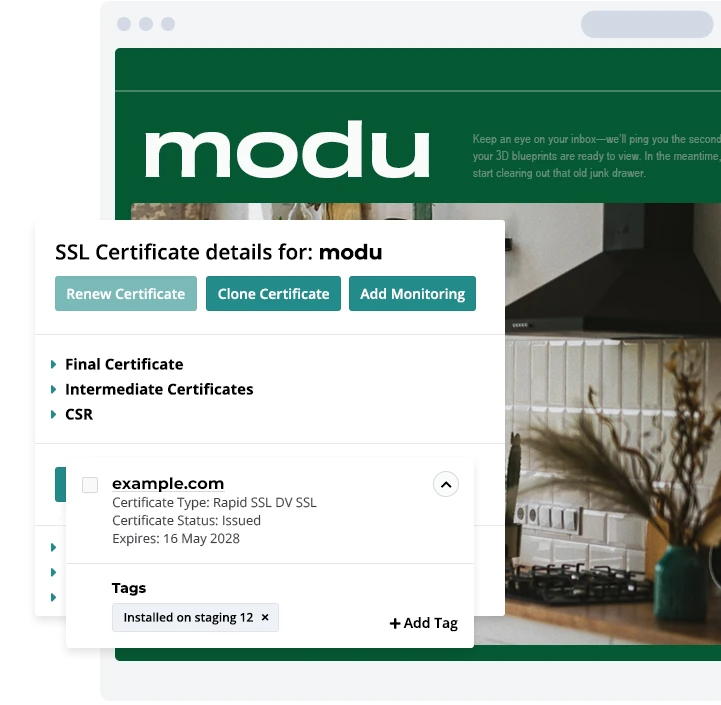
Modu using SSL management

SSL Certificate Automation and ACME:
Frequently Asked Questions

ACME-enabled SSL subscriptions are SSL certificate products designed to work with the ACME (Automated Certificate Management Environment) protocol.

They provide the certificate entitlement and enrollment credentials required for an ACME client to automatically request, validate, issue, install, and renew SSL certificates.

To achieve automation, an ACME-enabled SSL subscription must be used together with a compatible ACME client and a supported validation method.

ACME (Automated Certificate Management Environment) is an industry-standard protocol used to automate SSL certificate management.

Rather than manually requesting, installing, renewing, and replacing certificates, ACME-compatible software can perform these tasks automatically by communicating directly with participating Certificate Authorities.

The ACME protocol is supported by many popular hosting platforms, web servers, and certificate management tools.

Yes.

An ACME client is software that communicates with the Certificate Authority on your behalf and manages certificate issuance, validation, installation, and renewal Common ACME clients include:

  • Certbot
  • simple-acme
  • acme.sh
  • Plesk ACME

Some hosting platforms include built-in ACME functionality, while other environments require a separate ACME client.

Automated certificate management typically requires four components:

  • An ACME-enabled SSL subscription
  • A compatible ACME client
  • A supported validation method
  • Access to your DNS provider or hosting environment

Together, these components create an automated certificate management workflow.

After purchasing an ACME-enabled SSL subscription, you will:

  1. Retrieve your ACME enrollment details.
  2. Configure a compatible ACME client.
  3. Complete an initial domain validation.
  4. Issue your first certificate.

Once configured, many environments can automate certificate issuance, validation, renewal, and replacement with minimal ongoing administration.

Yes.

Wildcard certificates are supported when using DNS-01 validation.

Wildcard certificates allow a single certificate to secure multiple subdomains under the same domain name.

ACME deployments typically use one of two validation methods:

DNS-01 Validation
Domain ownership is verified using DNS TXT records. This is the preferred method for wildcard certificates and many fully automated deployments.

HTTP-01 Validation
Domain ownership is verified using a temporary validation file hosted on a web server.

This method is commonly used when DNS automation is unavailable or unnecessary.

In a properly configured ACME deployment, certificate renewal can be automated.

Your ACME client monitors certificate expiration dates and requests replacement certificates before they expire.

The subscription itself remains subject to its normal billing and renewal terms.

No.

ACME-enabled SSL subscriptions can be used with Webnames DNS Hosting or many third-party DNS providers, including platforms that support automated DNS validation workflows.

The available automation options depend on the DNS provider and ACME client being used.

ACME is supported by many modern hosting and server environments, including:

  • Apache
  • NGINX
  • Microsoft IIS
  • Plesk
  • cPanel
  • DirectAdmin
  • Kubernetes and cert-manager
  • Traefik
  • Caddy
  • HAProxy

ACME compatibility ultimately depends on the capabilities of the hosting platform or ACME client being used.

The certificate industry is moving toward shorter certificate validity periods, which means certificates will require more frequent renewal.

Automation helps organizations:

  • Reduce administrative effort
  • Minimize renewal-related outages
  • Improve certificate visibility
  • Scale certificate management across multiple systems

For many organizations, ACME is becoming the preferred approach to managing SSL certificates efficiently.

Traditional SSL certificates and ACME-enabled SSL subscriptions provide the same SSL/TLS encryption and browser trust.

The primary difference is how certificates are managed.

Traditional SSL Certificate ACME-Enabled SSL Subscription
Manual renewal Automated renewal capabilities
Manual installation Supports automated deployment workflows
Manual lifecycle management Designed for automated lifecycle management
Administrator-driven ACME client-driven

ACME-enabled SSL subscriptions are designed for customers who want to reduce the operational overhead associated with SSL certificate management.

Close
Sign In to Your Account
Don't have an account? Sign up now
Forgot password
or sign in with