Choose from Canada's largest selection of trusted SSL certificates, including ACME-enabled options that automate installation and renewals. Keep ahead of cyber threats, without the manual work and errors.
Websites built to showcase a freelance profile, a professional portfolio or resume or blogs may not deal with a lot of sensitive data, but HTTPS protection is important to establish your credibility. A domain validated, single domain SSL is a great option that is easy, affordable and can also help your SEO efforts.
SSL/TLS for Small or Medium Business Websites
Small and Medium businesses typically use websites as a brochure or information and lead generation tool. You may also use subdomains or multiple domains for testing or specific applications. These SSL certificates offer terrific value and flexible features to cover SME requirements.
SSL/TLS for eCommerce or Large Corporate Websites
The security needs of a website that engages in eCommerce or represents financial institutions or large businesses are significant. The ideal corporate SSL certificate will include a reputable certificate authority, OV or DV validation, combined with flexibility provided by SAN and/or wildcard.
Single Domain Protection
Every website needs an SSL certificate, and we have an option for every budget. Secure one website with industry standard 256-bit encryption. Choose your preferred certification authority and higher level of validation to increase trust.
Multi Domain SAN SSL Certificates
Protect multiple domains and/or subdomains, including public web addresses, private hostnames and IP addresses, under one SSL certificate instead of purchasing and configuring separate ones. These certificates are also referred to as Subject Alternative Name (SAN) SSL.
Unlimited Subdomain Protection with Wildcards
Save money by securing your primary domain, as well as an unlimited number of subdomains (mail.example.ca, login.example.ca, shop.example.ca) under a single SSL certificate. Save time and effort by eliminating the need to reconfigure and reissue when you add future subdomains.
Domain Validation (DV)
Great for simple websites, one-person entities & small organizations. DV SSL certificates have the quickest issuance because only domain ownership must be established.
Organization Validation (OV)
Best for businesses, nonprofits and small eCommerce sites. Increase visitor confidence and boost your credibility by showing that your organization has gone though additional vetting to prove your authenticy.
Extended Validation (EV)
Best for businesses and organizations that want to convey a high level of trust to visitors. EV SSL is recommended for established brands, eCommerce websites and those who place a premium on making visitors feel safe. EV are the only SSL certificates that turn the visitor's browser bar green and are the highest-assurance certs available.
RapidSSL is a well-respected Certification Authority that prioritizes speed and quick implementation. With an incredibly fast, fully automated issuance process you can purchase a RapidSSL certificate and have it up and running in just minutes.
Thawte is a leading certificate authority known for fantastic value and great flexibility across a wide variety of SSL/TLS products ranging from Unified Communication Certificates (UCC) to entry level domain validated certificates.
GeoTrust is our best selling SSL brand and the world?s second largest provider of SSL certificates. A globally trusted security brand, its digital certificates enable organizations in over 170 countries worldwide to maximize the security of their online data and transactions cost-effectively.
Digicert is a highly reputed cybersecurity company with a fantastic array of SSL/TLS and PKI products. It is the world's largest high-assurance certificate authority, commanding 60% of the Extended Validation (EV) Certificate market, and 96% of organization-validated (OV) certificates globally.
Sectigo (formerly Comodo) is an established cybersecurity company and the world's largest Certification Authority and TLS/SSL vendor. With more than 1M certificates issued, Sectigo continues to grow in popularity.
Automated
{{certificateProduct.MarketingLabel}}
{{certificateProduct.ProductName}}
On Sale{{ctrl.dicSSLPricing[certificateProduct.ProductCode].Currency}}{{ctrl.dicSSLPricing[certificateProduct.ProductCode].PriceLabel}}/year
†††
Automated SSL Certificates use the ACME protocol for end-to-end lifecycle management, including enrolment, validation, issuance, installation, and renewal.
Choose from 8 best-in-class SSL certificates by leading CA brands — now fully automated. Never manually install or renew SSL again.
What SSL/TLS Owners Need to Know About Shorter Certificate Lifetimes
Beginning Spring 2026, the maximum lifespan of new SSL/TLS certificates will be reduced by nearly half, shifting from 398 days to just 200 days.
200
days
March 2026
100
days
March 2027
47
days
March 2029
This is just the first step in a multi-year, industry-wide initiative to enhance digital security.
SSL validity lifespans will continue to be reduced until March 2029, at which point renewals will occur every 47 days. Learn more & view upcoming scheduled changes.
Advanced Management Tools for Growing Certificate Portfolios
Streamline SSL certificate management at your organization with Webnames advanced toolkit. Easily tag, reissue, clone, revoke, monitor and automate your SSL/TLS certificates from a single place, making enterprise-level certificate administration more efficient and organized.
SSL Certificate Tagging
Organize and manage your SSL portfolio with flexible tagging and filtering. Quickly group, track, and report on certificates across your environment, helping IT teams stay in control and maintain visibility.
SSL Cloning, Instance Management & Revocation
Deploy certificates across multiple servers with built-in cloning and instance management. Easily replicate configurations for consistent deployments and revoke certificates instantly if a security issue arises.
SSL Certificate Monitoring
Stay ahead of issues with automated monitoring of certificate status and configuration across all hostnames. Receive alerts for expirations, downtime, and errors to ensure continuous protection. SSL Monitoring is available as an add-on per certificate.
ACME-Compatible DNS Automation
Automate SSL management at scale with DNS-based validation and certificate issuance through the Webnames API. Integrate with ACME clients using DNS-01 challenges to enable secure, scriptable workflows that reduce manual effort and minimize errors.
*ACME-compatible DNS automation is included with Domain and Account Management Toolkit
Does Your Website or Online Platform Need SSL?
Learn which websites, applications and online services require SSL/TLS protection
E-Commerce and marketplaces
Government and public service platform
Banking, finance, payment processing
External and internal email
Enterprise applications
File sharing and collaboration services
Platforms requiring login or authentication
Remote access connections
Healthcare and patient portals
Avoid "Not Secure" Browser Warnings
Visitors are automatically warned now if a website is "Not Secure" when it hasn't implemented an SSL certificate. Websites tagged as "Not Secure" by Chrome, Firefox and other browsers have been shown to scare potential customers away, impacting both revenue and reputation. An SSL certificate not only shows that your website is secure, it also independently validates your identity online.
An SSL certificate encrypts information that is sent to, and received by, your website so it cannot be viewed and/or intercepted by third parties. Here’s how the secure connection is established.
When a visitor comes to an SSL secured website, its browser will request the server to identify itself. The server, in return, sends back its SSL certificate information.
Next, the browser will confirm the validity of the SSL certificate and then send back a one-time encryption key for a secure session.
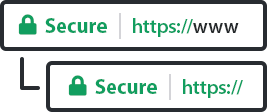
The server uses its private key to decrypt the session key it was provided, and establishes a secure, encrypted connection. Once the connection is complete, the padlock icon and HTTPS prefix will appear in the visitor's browser.
SSL Expertise Backed by Responsive Support
Organizations across Canada rely on Webnames for trusted SSL solutions, deep industry expertise, and responsive support. From simple website protection to large-scale SSL certificate management, we're here to help keep your organization and your customers secure.
"When I had a SSL issue arise, Webnames’ support team responded in nanoseconds and resolved my issue. This is the kind of response and support I have become accustomed to with Webnames."
Jack Graber www.homelink.ca
Frequently Asked Questions
Starting March 15, 2026, the maximum lifespan for SSL/TLS certificates will drop to 200 days. This is part of a phased global initiative to strengthen web security. Future reductions are scheduled for 2027 (to 100 days) and 2029 (to 47 days). These changes apply to all Certificate Authorities and browsers, regardless of where your domain is registered.
To learn more about these changes, check out our in-depth blog post about them or you can visit our help page dedicated to this topic.
Yes. You can continue to purchase 1-year terms and multi-year options (1-3 years) will also be available. While your purchase term does not change, the individual certificate files issued during that time will be shorter in duration. This means a 1-year SSL purchase will now consist of multiple certificates issued one after another at no extra cost.
The number of issuances depends on the year of purchase. In 2026, a 1-year term will require two certificates: one for the first 200 days and a second for the remaining 165 days. By 2029, a 1-year term will involve approximately 8 certificates, each valid for about 47 days. You will receive notices 3 weeks before a certificate expires to initiate the re-issuance process.
DCV is required to prove you control the domain associated with the certificate. The period for which you can reuse this validation is tied to certificate validity: 200 days in 2026, 100 days in 2027, and just 10 days by 2029. If a reissue or renewal falls outside of these windows, you must repeat the validation via email or DNS record.
For Organization Validated (OV) and Extended Validation (EV) certificates, the process for verifying your business identity is separate from DCV. While the certificate files follow the new shorter lifespans, your organization's identity is revalidated approximately once every 398 days. This verification focuses on your business documentation and status.
As validity periods shorten, manual management (which involves reissuing, downloading, and installing files) will happen much more frequently. Automation is strongly recommended to handle these tasks. Options like Plesk AutoInstall or ACME protocols can automatically manage the ordering, validation, and installation of certificates to prevent website downtime.
Encryption is the basis of secure web communications. The process turns plain text into cipher text to scramble data so it's not readable by anyone except the intended party. Historically, most websites have been served over HTTP or Hypertext Transfer Protocol which has one glaring flaw: it's not secure. Any information transmitted via an HTTP connection is easy to steal. Given that today we share all sorts of sensitive information online, including addresses, login IDs, password, credit card numbers and more. The browser community has pushed for the entire web, not just eCommerce site, to be encrypted. Encryption is enabled via an HTTPS connection.
When you are ready to install your SSL certificate, you can follow our step-by-step SSL Installation Guide. Should you require assistance at any stage of the purchase, configuration, verification and installation, simply reach out to our Customer Support Team for personal assistance.
Issuance time varies according to the validation level (DV, OV or EV) and Certificate Authority you choose. For information about issuance timelines on all the SSL certificates carried by Webnames.ca, visit our Approval and Validation help documentation in our SSL Guide.
Yes. Even if your website is a simple blog or brochure-style site, an SSL/TLS certificate is now expected.
Modern browsers and operating systems treat HTTPS as the default for the web. Sites served over HTTP can trigger security warnings, reduced trust signals, or limited functionality, even if they do not collect sensitive information. This applies to personal blogs, portfolio sites, and informational business websites alike.
An SSL/TLS certificate encrypts traffic between your website and visitors, protects against tampering, and confirms that users are connecting to the correct domain. It also supports search visibility, as HTTPS is a ranking factor used by major search engines.
For basic websites, a Domain Validation (DV) certificate is usually sufficient. DV certificates issue quickly, are cost-effective, and provides the encryption and HTTPS support required for modern browsers.
While all SSL certificates use the same technology and standard of encryption, the different certificate types have distinct requirements and characteristics.
Things that will factor into your decision include whether you have a personal or business website, the robustness of validation you desire, how many domains you need to protect and if your website uses subdomain.
Personal vs. Business Website
If you are running a blog, simple brochure website or internal facing domain for employees, a standard Domain Validation (DV) SSL certificate should give you the coverage you need. DV certificates have the added bonus of being the fastest to issue and can be authorized in minutes.
If you're invested in your reputation and place a high value on being perceived as trustworthy, a high assurance Organizational Validation (OV) SSL certificate is worth investing in. OV certificates validate that the domain belongs to a registered business and displays the validated company information in its site seal. OV certificates typically take a little longer to vet, approximately 1-3 business days.
Multiple Domain Names
If you have more than one domain name, a multi-domain (MD) SSL certificate will save you time and money. Multi-Domain certificates are a convenient choice for businesses that own multiple domains or TLD extensions, eliminating the need to purchase, install and manage separate SSL certificates for each one. These certificates cover all manners of fully qualified domain names (FQDNs) including publicly accessible web addresses, private hostnames, IP addresses and more. Multi-domain SSL certificates are available in DV, OV and EV options and many can extend their protection to 250+ domains.
Websites with Subdomains
If your primary domain has active subdomains - for example, mail.domain.com, shop.domain.com, members.domain.com, test.domain.com, dev.domain.com etc. - a Wildcard SSL certificate can be used to protect them all, as well as future ones that you might create. Wildcard SSL certificates cover one domain and an unlimited amount of subdomains and are available in DV and OV options.
Increasing Visitor Confidence
As indicated above, the vetting and validating process for DV, OV and EV certificates vary in intensity, with OV and EV requiring additional information and verifications such as confirmation of the business' ownership, and in the case of EV, that your business is registered with a government authority. Generally speaking, the more in-depth the validation, the more confidence and trust you establish with visitor. OV and EV certificates also include more prominent trust indicators that get displayed on your website.
SSL/TLS certificates are available in three validation levels. The difference between them is how the Certificate Authority (CA) verifies the identity behind the website, not how strong the encryption is. All validation types provide the same industry-standard encryption.
Domain Validation (DV)
Domain Validation confirms that the applicant controls the domain name. It does not verify the identity of an individual or business.
DV certificates issue quickly, often within minutes, and are well suited to blogs, personal websites, internal tools, and informational sites where encryption is required but identity assurance is less critical.
Organization Validation (OV)
Organizational Validation confirms both domain control and that the website is operated by a legitimate, registered organization. This involves verifying business details such as name, address, and legal status.
OV certificates are commonly used by businesses, nonprofits, and customer-facing websites that want to show visitors there is a real organization behind the site.
Extended Validation (EV)
Extended Validation uses the most detailed verification process. In addition to domain control, the CA performs an in-depth review of the organization's legal, physical and operational existence.
EV certificates are typically used by established brands, eCommerce sites and organizations where visitor confidence, transactions, or sensitive data are central to the site's purpose.
Choosing the Right Validation Level
The right validation level depends on what your website does and how much identity assurance you want to present to visitors. While all SSL/TLS certificates encrypt traffic, higher validation levels provide increasing levels of verified identity rather than stronger encryption.
Certificate Authorities (CAs) are globally trusted entities that issue SSL/TLS certificates and verifies the information associated with them. The CA's role is to confirm that a website is legitimately associated with the domain or organization requesting the certificate.
When a CA issues an SSL/TLS certificate, it digitally signs the certificate so browsers and operating systems can trust it. Web browsers maintain a built-in list of trusted certificate authorities, and they use this trust to decide whether a secure HTTPS connection should be considered valid.
CAs perform different levels of verification depending on the type of certificate being issued. This can range from confirming the control of a domain name to verifying the legal existence of a business or organization.
In practice, CAs enable HTTPS by acting as an independent party that browsers trust to verify website identity. Without this trust relationship, encrypted connections would still exist, but visitors would have no reliable way to confirm who they are actually connecting to.
The right SSL brand for your business depends on the level of trust you want to convey, how your website is used, and any industry or compliance requirements you need to meet. Webnames carries certificates from the major CA brands, all of which are widely trusted and compatible with modern browsers and devices.
Here's a short overview of the different CA brands Webnames carries:
Sectigo
Sectigo offers cost-effective SSL/TLS certificates that meet modern security standards. Their certificates are well suited to personal sites, informational sites, and small businesses that require reliable HTTPS encryption without a premium brand emphasis. Sectigo also offers entry-level certificates under the RapidSSL product line for basic use cases.
Thawte
Thawte provides a balance of trust, flexibility, and value. Their certificates are commonly used by small and mid-sized businesses that want a recognized global brand, along with options such as multi-domain and wildcard certificates, without moving into enterprise-level pricing.
DigiCert
DigiCert is a leading CA widely used by enterprises, government organizations, and businesses that require a high level of assurance. Their certificates are known for rigorous validation practices, strong brand recognition, and long-term security planning.
Webnames also offers GeoTrust-branded certificates, which are part of the DigiCert portfolio. GeoTrust certificates provide the same trusted root infrastructure as DigiCert while sitting at a more accessible price point. They are commonly chosen by organizations that want a well-recognized global brand and business-level trust without requiring enterprise-focused features.
DigiCert and GeoTrust certificates are used by organizations that prioritize verified identity, browser trust, and compatibility across modern devices.
All of these brands provide strong encryption and browser compatibility. The primary differences are in validation depth, brand recognition, feature sets, and target use cases, not in the underlying security of HTTPS itself.
The difference between Multi-Domain and Wildcard SSL certificates is how many and what types of hostnames they can protect.
A Multi-Domain SSL Certificate (also known as a SAN certificate) can secure secure multiple different domain names under a single certificate. For example, one certificate could cover example.ca, example.com and example.net. Additional domains can usually be added as needed, depending on the certificate.
Multi-domain certificates are a good fit for organizations that manage several websites, services, or brands across different domain names.
A Wildcard SSL Certificate secures one base domain and all of its subdomains. For example, a wildcard certificate for example.ca would cover www.example.ca, mail.example.ca, shop.example.ca, and any future subdomains under that domain.
Wildcard certificates are well suited to websites or applications that use many subdomains, or expect to add new subdomains over time.
In short:
Choose a multi-domain certificate if you need to secure multiple distinct domain names.
Choose a wildcard certificate if you need to secure many subdomains under a single domain name.
Both options provide the same TLS encryption, the difference is purely in how coverage is applied.
An SSL certificate warranty is a limited financial guarantee provided by the CA. It is designed to cover losses incurred by end users if a certificate fails due to an issuing or validation error by the CA itself.
SSL warranties do not protect against hacking, malware, data breaches, or server compromise. They also do not function as insurance for website owners. Instead, they apply only in rare cases where a certificate is incorrectly issued and that error directly contributes to a verified loss.
The warranty amount varies by certificate type and validation level, with higher assurance certificates typically including larger warranties. In practice, SSL warranties are rarely used, as modern certificate issuance and browser validation standards make qualifying failures uncommon.
The primary value of an SSL/TLS certificate remains encryption and verified identity. Warranties are an additional assurance feature rather than a core security control.
An SSL/TLS certificate is a digital certificate that enables an encrypted connection between a website and a visitor's web browser. It protects data in transit, confirms the identity of the website, and allows the site to be accessed over HTTPS.
TLS (Transport Layer Security) is the modern protocol used for encryption. SSL is an older term that is no longer technically used, but SSL Certificate remains the common name for TLS certificates.
When an SSL/TLS certificate is installed on a website:
Data exchanged between the browser and server is encrypted.
Visitors can verify they are connecting to the intended domain or organization.
Modern browsers display HTTPS to indicate a secure connection.
The level of identity information shown to visitors depends on the type of certificate issued, such as Domain Validation (DV), Organization Validation (OV), or Extended Validation (EV). Regardless of validation level, all SSL/TLS certificates provide strong, industry-standard encryption.
Modern SSL/TLS connections automatically negotiate strong encryption using current industry standards. Today, most browsers use secure 128-bit or 256-bit encryption by default, depending on performance and compatibility. Both are considered highly secure, and the difference between them is not meaningful for typical website traffic.
Some SSL/TLS certificates now support quantum-resistant (or post-quantum) cryptography. These certificates are designed to protect encrypted data against potential future attacks from large-scale quantum computers, which could weaken some traditional encryption methods.
For most websites, standard modern TLS encryption already provides strong protection. Quantum-resistant support is primarily about long-term security planning, data sensitivity, and regulatory or compliance considerations, rather than immediate risk.
All SSL certificates offered by Webnames.ca support modern encryption standards required by today's browsers, with select options available for organizations that want to prepare for emerging cryptographic threats.
Note: Quantum-resistant encryption does not replace standard TLS security today, but adds an additional layer for long-term data protection.
HTTP stands for Hypertext Transfer Protocol and it has been the accepted standard since 1997. It was the traditional way to serve up a website, even though it didn't provide a secure connection.
HTTPS stands for Hypertext Transfer Protocol Secure. It is the secure version of HTTP and uses encryption (via TLS) to protect the data, which helps prevent it from being read or altered while in transit.
In practical terms, HTTPS:
Encrypts information sent between a browser and a website.
Confirms the website's identity.
Displays the padlock icon in modern browsers.
When a site uses HTTPS, visitors can be confident they are connecting to the correct site and that their connection is private. Installing an SSL certificate means your website will be served up using HTTPS (HTTP + SSL/TLS) instead of HTTP, indicating an encrypted connection.
An SSL site seal is a visual badge provided by some CAs that website owners can display to show their site uses an SSL/TLS certificate. Depending on the certificate and provider, site seals may be static or dynamic badges that display verification details when clicked.
Today, site seals are optional. Modern browsers rely on HTTPS, encryption, and certificate verification rather than visual badges to establish trust. As a result, site seals are no longer a primary security indicator.
That being said, site seals can still be useful on pages where visitors are asked to sign in, submit personal information, or complete purchases. In these contexts, a visible seal may provide extra reassurance, especially for less technical users.
Note: Not all SSL/TLS certificates include a site seal, and displaying one is not required for HTTPS to function correctly.
Static Site Seals
Dynamic Site Seal
Site seals of SSL brands carried by Webnames.ca
RapidSSL
Static
Sectigo SSL
Static or dynamic
GeoTrust SSL
Dynamic
* Discounts to be applied in the shopping cart.
We use cookies to enhance our services. Click Accept to consent to default settings compliant with regulations in your jurisdiction, or manage your consent by clicking Preferences.