Overview
The Email Administration interface allows you to manage all aspects of email service for your domain from a single, centralized location within your Webnames account. From here, you can create and maintain individual mail accounts, configure aliases and distribution groups, control message routing rules, and manage important email authentication settings such as SPF Sender Policy Framework (SPF) is an email authentication method which ensures the sending mail server is authorized to originate mail from the email sender's domain., DKIM DomainKeys Identified Mail (DKIM) is an email authentication method designed to detect forged sender addresses in email (email spoofing), a technique often used in phishing and email spam.
DKIM allows the receiver to check that an email that claimed to have come from a specific domain was indeed authorized by the owner of that domain. It achieves this by affixing a digital signature, linked to a domain name, to each outgoing email message. The recipient system can verify this by looking up the sender's public key published in the DNS. A valid signature also guarantees that some parts of the email (possibly including attachments) have not been modified since the signature was affixed., and DMARC DMARC: Domain-based Message Authentication, Reporting & Conformance, is an email authentication, policy, and reporting protocol. https://dmarc.org/. Access to email management can also be delegated using dedicated user roles, enabling secure collaboration while maintaining appropriate control at the domain level. This section provides guidance on each area of the interface and explains how to perform common email administration tasks.
Sender Policy Framework (SPF) is an email authentication method which ensures the sending mail server is authorized to originate mail from the email sender's domain., DKIM DomainKeys Identified Mail (DKIM) is an email authentication method designed to detect forged sender addresses in email (email spoofing), a technique often used in phishing and email spam.
DKIM allows the receiver to check that an email that claimed to have come from a specific domain was indeed authorized by the owner of that domain. It achieves this by affixing a digital signature, linked to a domain name, to each outgoing email message. The recipient system can verify this by looking up the sender's public key published in the DNS. A valid signature also guarantees that some parts of the email (possibly including attachments) have not been modified since the signature was affixed., and DMARC DMARC: Domain-based Message Authentication, Reporting & Conformance, is an email authentication, policy, and reporting protocol. https://dmarc.org/. Access to email management can also be delegated using dedicated user roles, enabling secure collaboration while maintaining appropriate control at the domain level. This section provides guidance on each area of the interface and explains how to perform common email administration tasks.
To manage your domain's email accounts:
- CLICK HERE TO ACCESS YOUR WEBNAMES.CA EMAIL SERVICES
- Click the Email tab, and click the Manage button under Manage Accounts and Settings.
- Click Mail Accounts in the left margin.
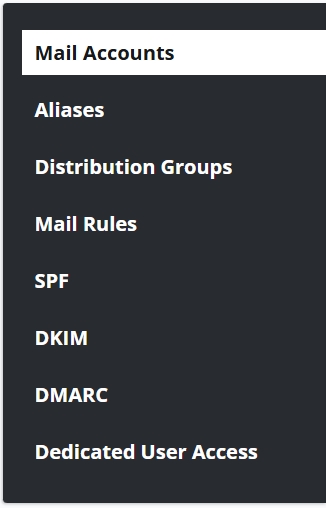
From here you can add new email accounts, as well as update account settings, delete, or change passwords for existing email accounts.
Alternate recovery mail addresses can also be specified for each account. In the case of a forgotten email password, users can have their password be sent to them via the alternate recovery mail address.
| NOTE:When creating new email accounts, current password requirements are: Minimum 8 characters, containing both uppercase and lower case characters, as well as at least 1 number. |